Volume 16, Number 7-9, 2009
Updated: 2010-04-30 07:27:55
Composite Interfaces, Volume 16, Number 7-9, 2009.
Loaded on 2009-11-05

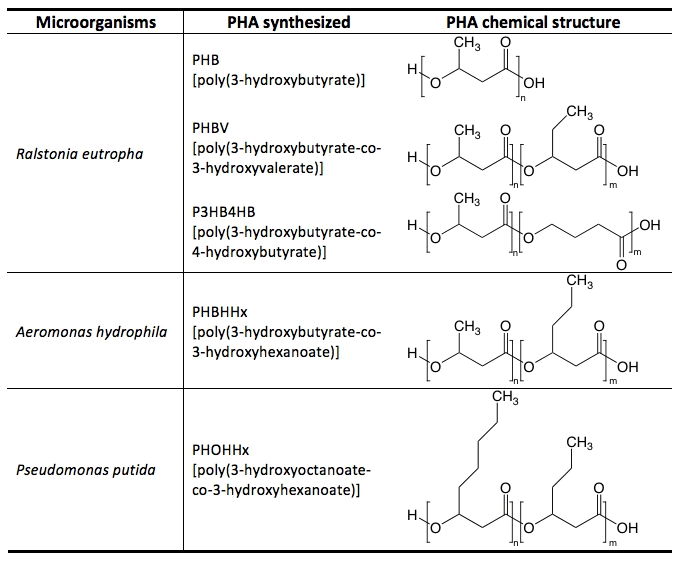 PHA stands for “Polyhydroxyalkanoate”, a family of biopolyesters synthesized by a variety of microorganisms.
PHAs are bioplastics. Their properties are similar to many petroleum based thermoplastics and elastomeric materials. But unlike most petroleum plastics, PHAs are sustainable, biodegradable and biocompatible.
Sustainable: Naturally, many microorganisms can synthesize PHA from a wide variety of organic matter. These include sugars, [...]
PHA stands for “Polyhydroxyalkanoate”, a family of biopolyesters synthesized by a variety of microorganisms.
PHAs are bioplastics. Their properties are similar to many petroleum based thermoplastics and elastomeric materials. But unlike most petroleum plastics, PHAs are sustainable, biodegradable and biocompatible.
Sustainable: Naturally, many microorganisms can synthesize PHA from a wide variety of organic matter. These include sugars, [...] Despite the recent global economic slowdown, the global biodegradable polymers market grew stronger and doubled its market size from 2005-2009. This market is positioned to grow 13% annually between 2009 and 2014.</p
Recently, SRI Consulting (SRIC) released its global Biodegradable Polymers report that provides the most comprehensive and timely information on the worldwide biodegradable polymers industry.
Overall, [...]
Despite the recent global economic slowdown, the global biodegradable polymers market grew stronger and doubled its market size from 2005-2009. This market is positioned to grow 13% annually between 2009 and 2014.</p
Recently, SRI Consulting (SRIC) released its global Biodegradable Polymers report that provides the most comprehensive and timely information on the worldwide biodegradable polymers industry.
Overall, [...] A new biobased and industrially produced polyamide:
Evonik Industries has expanded its range of compounds for high-performance cables to include bio-based VESTAMID® Terra DS. This polyamide 1010 (PA 10.10) is produced entirely from monomers obtained from castor oil. Castor oil is in turn obtained from the bean of the castor oil plant, which is used neither as food [...]
A new biobased and industrially produced polyamide:
Evonik Industries has expanded its range of compounds for high-performance cables to include bio-based VESTAMID® Terra DS. This polyamide 1010 (PA 10.10) is produced entirely from monomers obtained from castor oil. Castor oil is in turn obtained from the bean of the castor oil plant, which is used neither as food [...] TECNARO GmbH, produces sustainable materials for the automotive and packaging industries and also for the manufacturers of furniture, toys, musical instruments and shoes, based on thermoplastics made of lignins.
TECNARO GmbH, which stands for TEChnologie NAchwachsender Rohstoffe (Technology of renewable resources) is a spin-off company of the Fraunhofer Institute for Chemical Technology (ICT) in Pfinztal [...]
TECNARO GmbH, produces sustainable materials for the automotive and packaging industries and also for the manufacturers of furniture, toys, musical instruments and shoes, based on thermoplastics made of lignins.
TECNARO GmbH, which stands for TEChnologie NAchwachsender Rohstoffe (Technology of renewable resources) is a spin-off company of the Fraunhofer Institute for Chemical Technology (ICT) in Pfinztal [...] After several recent and negative news or statements, concerning the “oxo-degradables” (also called “oxo-biodegradables”), a last study funded by the UK Government is published by the Defra (Dep. for environment food and rural affairs). They showed that some plastics marked as ‘degradable’ might not be as environmentally-friendly as consumers think.
The study, carried out by Loughborough [...]
After several recent and negative news or statements, concerning the “oxo-degradables” (also called “oxo-biodegradables”), a last study funded by the UK Government is published by the Defra (Dep. for environment food and rural affairs). They showed that some plastics marked as ‘degradable’ might not be as environmentally-friendly as consumers think.
The study, carried out by Loughborough [...] Verdezyne, Inc., a privately-held synthetic biology company developing processes for renewable chemicals and fuels, announced they are developing a new fermentation process for the production of adipic acid. This company achieved proof of concept by demonstrating production and recovery of adipic acid by a yeast microorganism from an alkane feedstock. Using proprietary technologies, Verdezyne discovered and [...]
 Bioplastics division of Stanelco plc has been rebranded Biome Bioplastics Limited. As the bioplastics division has seen continued high levels of growth through the development of new technologies, Stanelco has decided to create a new brand.
“Stanelco’s bioplastics business has continued to achieve high levels of growth over the last two years, making us one of the [...]
Bioplastics division of Stanelco plc has been rebranded Biome Bioplastics Limited. As the bioplastics division has seen continued high levels of growth through the development of new technologies, Stanelco has decided to create a new brand.
“Stanelco’s bioplastics business has continued to achieve high levels of growth over the last two years, making us one of the [...] Braskem and Novozymes take a step toward the bio-based economy by developing polypropylene from sugarcane.
Braskem, the largest petrochemical company in Latin America, and Novozymes, the world’s leading producer of industrial enzymes, announced a research partnership to develop large-scale production of polypropylene from sugarcane.
“Braskem was the first company in the world to produce a 100% certified [...]
Braskem and Novozymes take a step toward the bio-based economy by developing polypropylene from sugarcane.
Braskem, the largest petrochemical company in Latin America, and Novozymes, the world’s leading producer of industrial enzymes, announced a research partnership to develop large-scale production of polypropylene from sugarcane.
“Braskem was the first company in the world to produce a 100% certified [...] Bioplastics: Ten Points To Remember, from European Bioplastics
1. Bioplastics are a family of different resin types, which are either bio-based or compostable or both. Bioplastics add new properties and performance characteristics to the huge family of plastics. So-called oxo-biodegradable polymer products, which fragment into small pieces, are not considered to be a bioplastic.
2. Bioplastics have been developed [...]
Bioplastics: Ten Points To Remember, from European Bioplastics
1. Bioplastics are a family of different resin types, which are either bio-based or compostable or both. Bioplastics add new properties and performance characteristics to the huge family of plastics. So-called oxo-biodegradable polymer products, which fragment into small pieces, are not considered to be a bioplastic.
2. Bioplastics have been developed [...] My favorite part about working on R&D projects is that they tend to challenge you to think outside the box, try new things, and learn about the latest technologies. One of our recent development projects involved injection molding a long, thin-walled tube (picture a miniature drinking straw) with a wall [...]